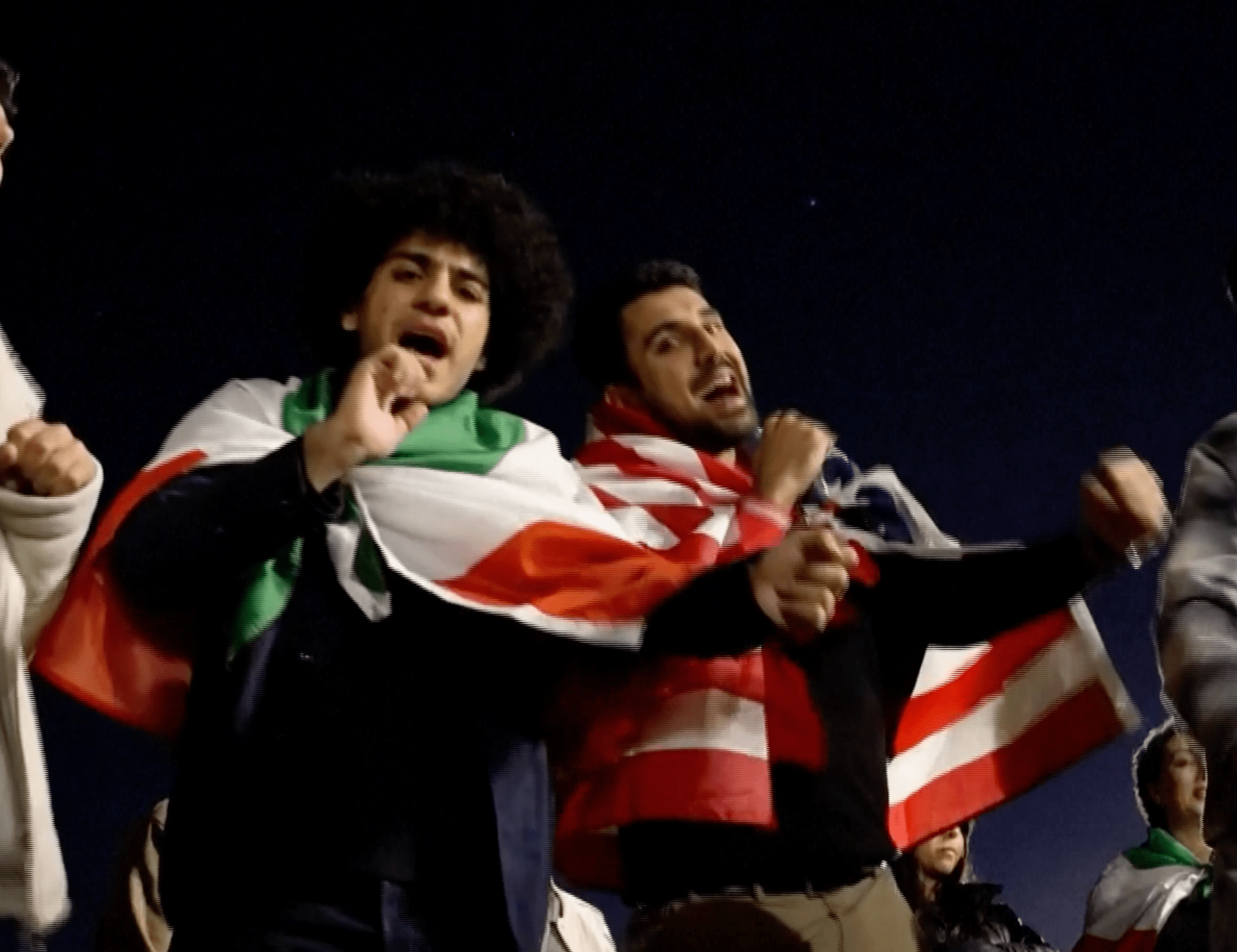
**Iranian Diaspora Celebrates Persian Festival Wrapped in U.S., Israeli Flags**
Members of the Iranian diaspora gathered in large numbers to celebrate a major Persian festival, with many participants draped in U.S. and Israeli flags in a striking display of political symbolism alongside cultural pride.
The event, held as part of seasonal Persian festivities commonly observed by Iranians around the world, blended traditional celebration with pointed messages of solidarity, identity and opposition to the Iranian government. Videos and images shared online showed attendees waving Iranian pre-revolutionary flags as well as American and Israeli flags, underscoring the political tone of the gathering.
Organizers and participants framed the celebration as more than a cultural event. For many, it was also an expression of support for the Iranian people and a rejection of the Islamic Republic. The presence of U.S. and Israeli symbols reflected a segment of the diaspora that views both countries as important allies in confronting Tehran’s leadership.
### What happened
The festival brought together Iranian expatriates and their families for music, dancing and traditional customs associated with Persian seasonal celebrations. But the event also drew attention for the large number of people carrying or wearing American and Israeli flags.
Witnesses and social media posts indicated that the crowd included activists and anti-government demonstrators, some chanting slogans against Iran’s ruling system. In addition to festive activities, participants used the occasion to highlight calls for political change in Iran and to show solidarity with protest movements inside the country.
The dual display of Persian tradition and overt geopolitical symbolism made the gathering stand out from many diaspora cultural events, which are often less explicitly political.
### Why it matters
The event illustrates how cultural celebrations among the Iranian diaspora have increasingly become venues for political expression, especially since waves of anti-government protests in Iran in recent years.
It also highlights internal divisions over identity and alliances among Iranians abroad. While some diaspora communities focus primarily on preserving language, heritage and customs, others have embraced public political messaging tied to Iran’s domestic unrest and its regional tensions with Israel and the United States.
The display of Israeli flags is particularly significant given the Islamic Republic’s longstanding hostility toward Israel. For supporters, the gesture signals a rejection of Tehran’s foreign policy and an embrace of alternative political alignments. Critics, however, may see it as provocative or unrepresentative of broader Iranian public sentiment.
The appearance of U.S. flags carries similar weight. It reflects both gratitude among some expatriates for life in America and a belief that Washington should continue backing pressure on Tehran. At the same time, such imagery can be controversial because of the complex history between Iran and the United States.
### Background
Persian festivals such as Nowruz, the Persian New Year, and Chaharshanbe Suri, the fire festival held in the days leading up to it, are central to Iranian cultural life and are celebrated by millions across Iran and the global diaspora.
For decades, Iranian communities abroad have used these occasions to preserve traditions disrupted by exile, migration and political upheaval following the 1979 Islamic Revolution. Over time, diaspora gatherings have also evolved into spaces where political identity is expressed openly, particularly among monarchists, secular activists and other opponents of the current Iranian state.
The use of the pre-revolutionary lion-and-sun flag is common at such events, especially among those who oppose the Islamic Republic. In recent years, after nationwide protests and intensified crackdowns in Iran, diaspora activism has become more visible in cities across North America and Europe.
The inclusion of Israeli flags reflects an emerging trend among some anti-government Iranian activists who argue that enmity toward Israel is a policy of the state, not the people. That view remains contested, both within Iran and among Iranians abroad.
### Q&A
**Q: What festival was being celebrated?**
A: Reports described it as a Persian festival observed by the Iranian diaspora, likely tied to seasonal traditions such as Nowruz or Chaharshanbe Suri.
**Q: Why were U.S. and Israeli flags present?**
A: Many participants appeared to use the flags as political symbols, signaling opposition to Iran’s government and support for countries seen by some activists as counterweights to Tehran.
**Q: Was the event cultural or political?**
A: It was both. The gathering centered on Persian cultural celebration but also served as a platform for political expression.
**Q: Why is the Israeli flag especially notable?**
A: Iran’s government has long positioned itself as strongly anti-Israel, so public displays of Israeli flags by Iranians carry strong symbolic and political meaning.
**Q: Does this represent all Iranians in the diaspora?**
A: No. The Iranian diaspora is diverse, and views on politics, identity and international alliances vary widely.
As Persian festivals continue to bring together Iranian communities abroad, such gatherings are increasingly reflecting not only shared heritage but also the deep political debates shaping the diaspora’s relationship with Iran, the West and the wider Middle East.