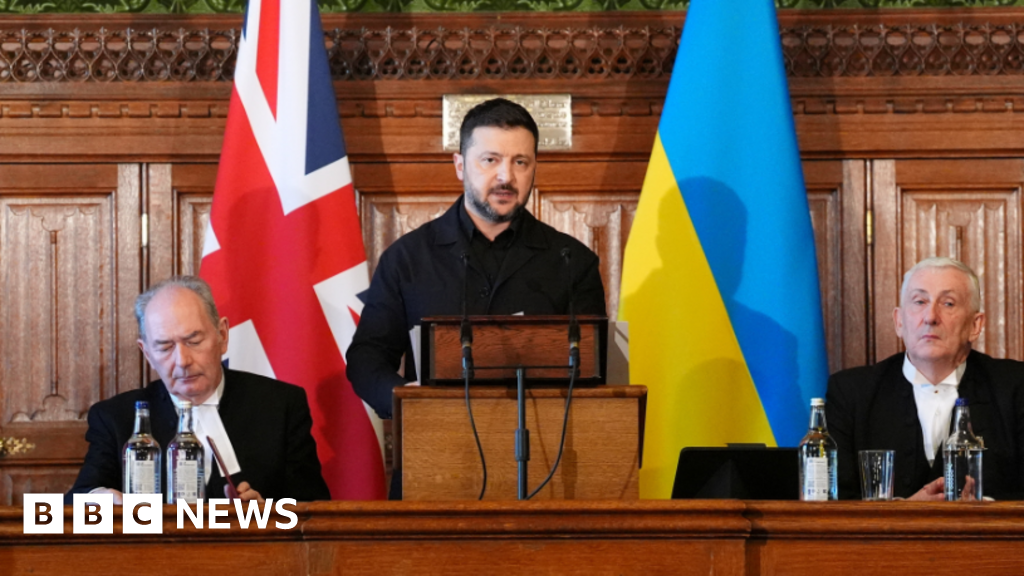
# Iran and Russia are “brothers in hatred”, Zelensky tells MPs
Ukrainian President Volodymyr Zelensky has accused Iran and Russia of acting as “brothers in hatred,” using a direct address to lawmakers to sharpen his criticism of the military and political ties between Moscow and Tehran.
Speaking to MPs, Zelensky said the partnership between the two countries was helping fuel Russia’s war against Ukraine, particularly through the supply of Iranian-made drones that have been used in attacks on Ukrainian cities and infrastructure. His remarks were among his clearest attempts yet to frame Iran not only as a Russian partner, but as an active enabler of the conflict.
## What happened
In his address to members of parliament, Zelensky condemned the cooperation between Russia and Iran, arguing that both governments were united by hostility toward freedom, democracy and international stability. He described them as “brothers in hatred,” a phrase aimed at underlining what Kyiv sees as a dangerous alliance built around repression and war.
The Ukrainian leader’s comments come as Russia has continued to rely on drone and missile attacks across Ukraine, often targeting energy facilities, residential areas and other civilian infrastructure. Kyiv and its Western allies have repeatedly said Iranian-designed Shahed drones have played an important role in those strikes.
Zelensky urged lawmakers to maintain pressure on Moscow and its partners, calling for stronger sanctions, tighter controls on military technology transfers and continued support for Ukraine’s air defences.
## Why it matters
Zelensky’s comments matter because they highlight the increasingly international nature of the war in Ukraine. What began as Russia’s full-scale invasion in February 2022 has evolved into a conflict shaped not only by Russian military power, but also by outside suppliers and geopolitical alliances.
By publicly linking Iran to Russia’s campaign, Zelensky is seeking to:
– build support for tougher sanctions on Tehran;
– persuade allies that aid to Ukraine is also part of a broader effort to contain authoritarian cooperation;
– draw attention to the threat posed by drone warfare;
– reinforce the case for more air-defence systems and ammunition.
His intervention also reflects wider concern in Europe and beyond that Russia’s defence partnerships are helping it sustain long-term attacks despite heavy battlefield losses and sanctions pressure.
## Background context
Ukraine has for months accused Iran of supplying drones and other military support to Russia. Tehran has at times acknowledged sending drones to Moscow, though Iranian officials have disputed the scale and timing of those transfers and have denied providing weapons for use after the start of the full-scale invasion. Russia and Iran have meanwhile deepened broader political, economic and military ties.
The Shahed drones, often used in large waves, have become a prominent feature of Russia’s strategy. They are relatively cheap compared with many missiles and can be used to overwhelm air defences, terrorise civilians and damage power infrastructure.
The issue has become part of a larger diplomatic battle. Western governments have imposed sanctions on Iranian entities linked to drone production and transfers, while Ukraine has sought to isolate both Moscow and Tehran internationally.
Zelensky’s language also fits a broader pattern in his wartime messaging: portraying Ukraine’s struggle as part of a global contest between democratic states and authoritarian regimes. By describing Russia and Iran in such stark terms, he is appealing to lawmakers not just on security grounds, but on moral and political ones.
## Wider implications
The remarks come at a time when Ukraine continues to press partners for sustained military and financial backing. As the war grinds on, Kyiv is trying to ensure that international attention does not fade and that countries supplying or supporting Russia face greater consequences.
If lawmakers respond with new sanctions or increased military assistance, Zelensky’s intervention could have practical effects beyond rhetoric. It may also add to diplomatic pressure on governments that have tried to keep a degree of distance from the conflict but remain engaged with Iran or Russia.
At the same time, the comments risk further inflaming already tense relations, especially as Russia and Iran have both rejected accusations that they are jointly responsible for attacks on civilians.
## Q&A
### What did Zelensky say?
He told MPs that Iran and Russia were “brothers in hatred,” accusing them of working together against Ukraine and against wider democratic values.
### Why did he target Iran as well as Russia?
Ukraine says Iran has helped Russia’s war effort, especially by supplying drones used in attacks on Ukrainian territory.
### What are Shahed drones?
They are Iranian-designed attack drones that can be launched in large numbers to strike targets or exhaust air-defence systems.
### Why is this significant internationally?
It underscores that the war is not only a confrontation between Ukraine and Russia, but also one affected by outside military suppliers and strategic alliances.
### How have Iran and Russia responded to such accusations in the past?
Both countries have generally rejected or downplayed claims that Iranian military support has directly enabled Russian attacks on Ukraine.
### What is Zelensky hoping to achieve?
He is seeking stronger international backing for Ukraine, tougher sanctions on Russia and Iran, and more defensive weapons to protect Ukrainian cities and infrastructure.