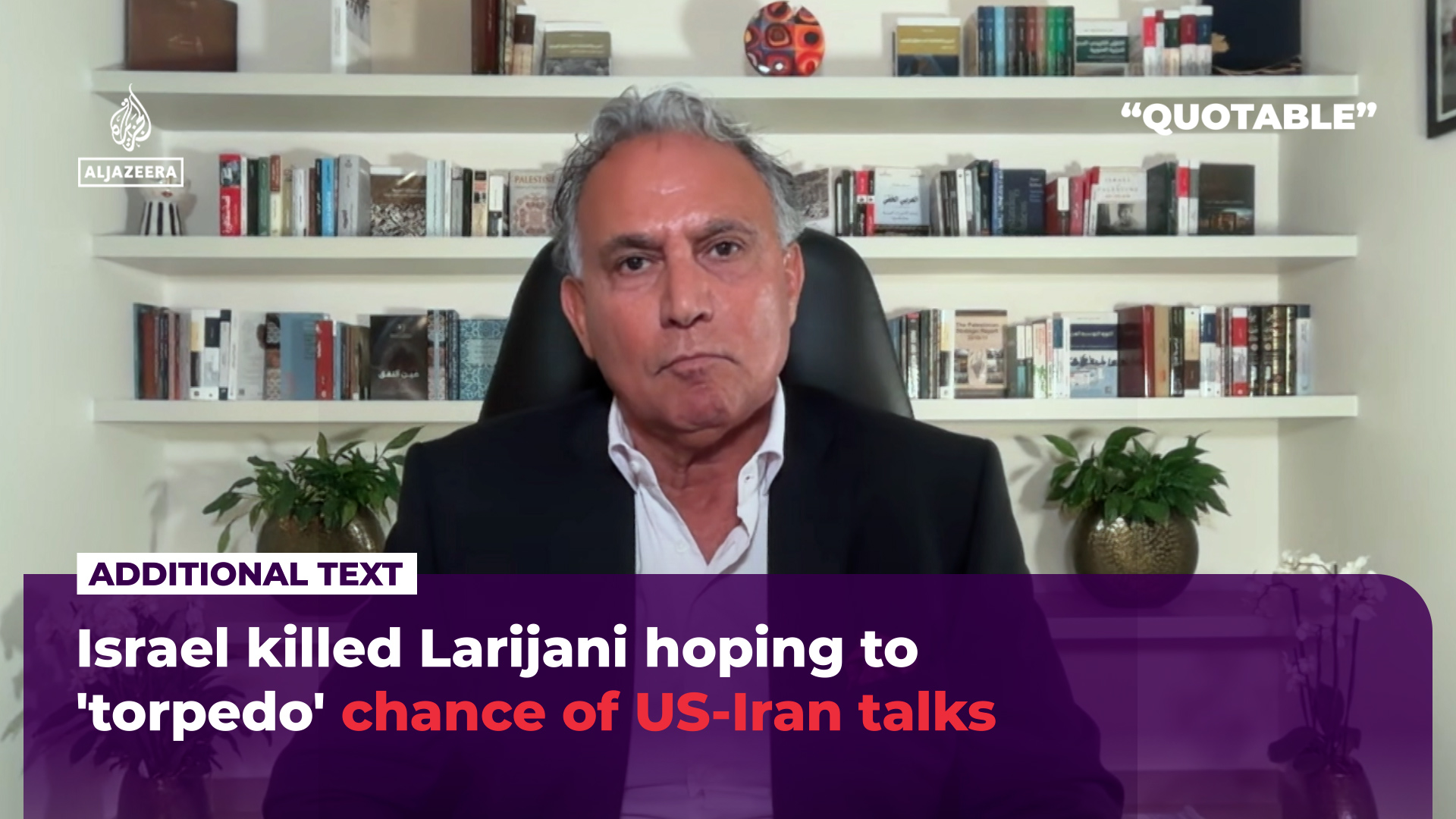
## Israel killed Larijani hoping to ‘torpedo’ chance of US-Iran talks
**By [Staff Writer]**
Israel’s killing of senior Iranian political figure **Ali Larijani** appears to have been aimed not only at weakening Tehran’s leadership circle, but also at derailing any renewed diplomatic opening between the **United States and Iran**, according to analysts and regional observers.
The strike, which has sharply heightened tensions across the Middle East, comes at a moment when speculation had been growing over whether indirect or backchannel contacts between Washington and Tehran might eventually revive stalled diplomacy over Iran’s nuclear programme and regional security issues.
### What happened
Ali Larijani, a veteran conservative politician and former senior state official, was killed in what Iranian officials and multiple regional reports described as an **Israeli attack**. Israeli authorities have not publicly detailed the operation, in keeping with their frequent policy of ambiguity around high-profile assassinations and covert actions.
Iran condemned the killing as a major escalation and accused Israel of seeking to provoke a wider confrontation. The assassination immediately triggered strong reactions in Tehran, where Larijani was seen as an influential establishment figure with deep ties across Iran’s political, military and security institutions.
While Larijani was not the supreme decision-maker in Iran, his death removes a prominent figure who had long played a role in strategic state deliberations and who, at times, was viewed as capable of navigating between hardline and pragmatic factions within the Islamic Republic.
### Why it matters
The killing matters for several reasons.
First, it risks **further inflaming already severe tensions** between Israel and Iran, two adversaries engaged in a long-running shadow war involving assassinations, cyberattacks, sabotage and proxy conflict across the region.
Second, it could **undermine the prospects for any US-Iran diplomatic engagement**. Analysts say that if there were even a narrow chance of exploratory talks, a strike of this magnitude would likely strengthen anti-negotiation voices in Tehran. Iranian leaders may now calculate that entering talks after such an attack would be seen domestically as weakness.
Third, the assassination may have been intended to **narrow Washington’s options**. By escalating the confrontation, Israel could be seeking to make it politically and strategically harder for the United States to pursue diplomacy, especially at a time when US policymakers remain divided over how to handle Iran’s nuclear advances and regional influence.
“This kind of operation can serve multiple objectives at once: eliminating a senior figure, demonstrating reach, and complicating diplomacy,” one regional analyst said. “If there was concern in Israel that US-Iran channels could reopen, a strike like this could effectively torpedo that possibility.”
### Background
Larijani was one of Iran’s best-known establishment politicians, having held several top positions over the years, including roles linked to parliament, national security and state broadcasting. He was widely regarded as a loyal insider of the Islamic Republic, though not always aligned with the most rigid ideological camp.
His political stature made him more than just another official. He represented continuity within the Iranian system and had influence among elite decision-makers. Because of that, his death is being interpreted not merely as a tactical strike, but as a signal aimed at the broader Iranian state.
Israel and Iran have for years been locked in a covert conflict. Israel has repeatedly accused Iran of pursuing military nuclear capabilities and of arming militant groups hostile to Israel, including **Hezbollah** and other regional proxies. Iran denies seeking nuclear weapons and says its regional alliances are part of a broader deterrence strategy.
The United States, meanwhile, has oscillated between pressure and diplomacy in its Iran policy. Efforts to restore or replace the 2015 nuclear deal have repeatedly stalled. Even so, the possibility of limited talks or indirect understandings has never fully disappeared.
That is why Larijani’s killing is being viewed through a broader geopolitical lens: not simply as another blow in the Israel-Iran confrontation, but as a move with potential consequences for **US strategy, regional stability and the future of diplomacy**.
### Immediate fallout
The immediate consequences are likely to include tighter security measures inside Iran, possible retaliation by Tehran or allied groups, and renewed fears of a spiral that could draw in other regional actors.
For Washington, the strike creates a more difficult landscape. US officials may now face increased pressure to back Israel publicly while also trying to prevent the crisis from expanding into a direct regional war. At the same time, any effort to pursue talks with Tehran could become even more politically fraught.
Whether that was the precise objective behind the killing may remain unclear in the absence of official confirmation. But the timing and target have fueled a growing view among observers that the operation was designed to do more than eliminate a single man.
—
## Q&A
### Who was Ali Larijani?
Ali Larijani was a prominent Iranian conservative politician and longtime establishment insider who held a number of senior state positions. He was considered influential within Iran’s political and security system.
### What has Israel said?
Israel has not publicly provided a full account of the reported operation. Israeli governments often avoid direct confirmation of targeted assassinations and covert actions.
### Why would the killing affect US-Iran talks?
A high-profile assassination can harden positions in Tehran, empower opponents of diplomacy and make any engagement with Washington politically toxic for Iranian leaders.
### Why would Israel want to stop US-Iran talks?
Critics and some analysts argue Israel fears that renewed diplomacy could ease pressure on Iran without permanently curbing its nuclear capabilities or regional power. From that perspective, disrupting talks could preserve a strategy of maximum pressure and confrontation.
### Could Iran retaliate?
Yes. Iran could respond directly, through allied armed groups, or through cyber and covert means. However, the scale and timing of any response would depend on Tehran’s calculations about deterrence, domestic politics and the risk of broader war.
### What happens next?
Much depends on Iran’s response, US efforts to contain the fallout, and whether the crisis remains limited or expands. In the near term, the chances of meaningful US-Iran diplomacy appear significantly diminished.